HOW CAN WE HELP?
Call us at 860.747.6333 or submit an information request form and someone will get back to you within 48 hours.
Reliable Liquid Acquisition. Vapor-Free Propellant Delivery.
Engineered porous metal structures that prevent gas ingestion and maintain consistent liquid propellant flow in spacecraft propulsion systems.
Download the Surface Tension Elements Technical Datasheet
Surface Tension Elements leverage capillary forces within engineered porous structures to preferentially transport liquid while rejecting gas. This enables reliable liquid acquisition in microgravity, low-gravity, and dynamic flight environments where traditional fluid management approaches can struggle.
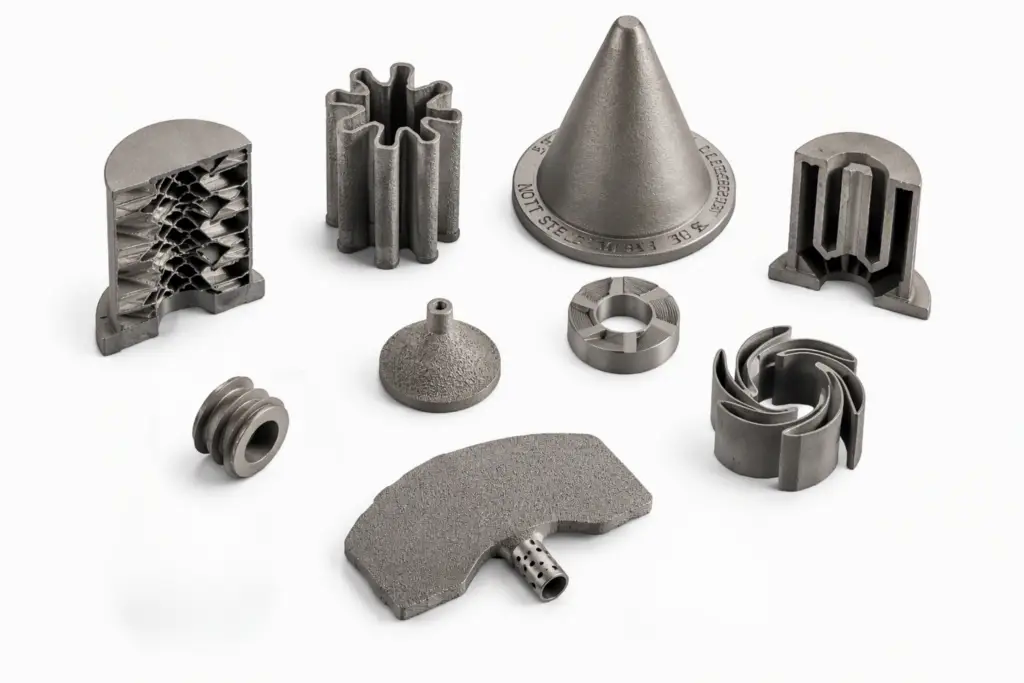
| Parameter | Specification |
|---|---|
| Manufacturing Method | Laser Powder Bed Fusion (LPBF) |
| Available Materials | Ti-6Al-4V, 316L Stainless Steel, Inconel 625 |
| Porosity Range | 0–50% |
| Pore Size Range | 1–100 Microns |
| Feature Resolution | ±0.015″ (solid), ±0.020″ (porous) |
| Flow Consistency | ±10% |
| Build Volume | 9.7″ × 9.7″ × 13″ |
| Dimensional Consistency | ±0.001″–0.002″ |
| Machined Surface Finish | 5–32 μin Ra |
| Capability | Engineering Value |
|---|---|
| Gradient Porous Structures | Controlled liquid transport and capillary performance |
| Vapor Rejection | Minimizes gas ingestion risk |
| Capillary Wicking | Reliable liquid acquisition in low-gravity environments |
| Tunable Porosity | Performance tailored to mission requirements |
| Additive Manufacturing | Complex geometries beyond traditional manufacturing limits |
| Integrated Structures | Porous and solid features built as a single component |
| Lightweight Designs | Reduced system mass and footprint |
| Rapid Iteration | Faster development and optimization cycles |
| Material | Application Advantages |
|---|---|
| Ti-6Al-4V Titanium | High strength-to-weight ratio for spacecraft applications |
| 316L Stainless Steel | Corrosion resistance and manufacturing versatility |
| Inconel 625 | High-temperature and chemically aggressive environments |
| Custom Aerospace Alloys | Available for mission-specific requirements |
Helps prevent vapor ingestion into propulsion and fluid management systems.
Supports high levels of fluid extraction to maximize usable onboard propellant.
Optimized geometries reduce component weight while maintaining performance.
Rapid iteration enables faster design refinement and qualification.
Complex internal structures enable performance levels difficult to achieve with conventional fabrication methods.
Porosity gradients and pore structures can be customized for application requirements.
Manufactured in Mott’s AS9100-certified facility in Farmington, Connecticut, supporting mission-critical aerospace and defense applications.
Work directly with Mott engineers to develop STE solutions tailored for spacecraft propulsion, fluid management, and next-generation space systems.

Join our newsletter to stay up to date on features and releases
Call us at 860.747.6333 or submit an information request form and someone will get back to you within 48 hours.
Headquarters:
75 Spring Lane
Farmington, CT 06032
Customer Innovation Center:
84 Spring Lane
Farmington, CT 06032