HOW CAN WE HELP?
Call us at 860.747.6333 or submit an information request form and someone will get back to you within 48 hours.
Precision Propellant Distribution for Electric Propulsion Systems
Mott’s electric propulsion manifolds leverage proven porous metal flow restrictors and solenoid valves to deliver stable, calibration-free flow control and accurate anode-to-cathode flow splitting. By eliminating resonance associated with supersonic orifices and reducing FOD risk, these manifolds support reliable propulsion performance. Fully assembled and qualified in Mott’s AS9100 U.S. facilities, they are engineered for launch survivability and production scalability demanded by modern satellite constellations.
Download the Electric Propulsion Filter Datasheet
Hall Effect Thrusters • Ion Thrusters • Xenon Feed Systems • Satellite Propulsion Platforms • Spacecraft Fluid Management Systems • Flow Splitting Assemblies • Integrated Propulsion Subsystems
Custom internal flow architectures provide balanced propellant delivery across propulsion systems to support consistent thruster performance.
One supplier, complete subsystem accountability from design and procurement through manufacturing, assembly, and delivery.
Incorporate flow restrictors, fluid channels, and valves directly into the manifold design.
Single-source manufacturing and qualification testing streamlines validation, reduces risk, and ensures full accountability from build through flight readiness.
Engineered internal geometries support efficient fluid routing and improved flow uniformity throughout propulsion systems.
Built on Mott's extensive experience supporting spaceflight propulsion, filtration, and fluid management applications.
Today’s satellite constellation manufacturers face challenges that are driven as much by manufacturing scalability, consistent quality, and schedule demands as they are by the technical design.
By pairing aerospace propulsion expertise with high-volume manufacturing capabilities refined in the semiconductor and healthcare industries, Mott is uniquely positioned to deliver industry-leading electric propulsion manifolds for satellite constellations.
The Porous Metal Advantage in Electric Propulsion Manifolds
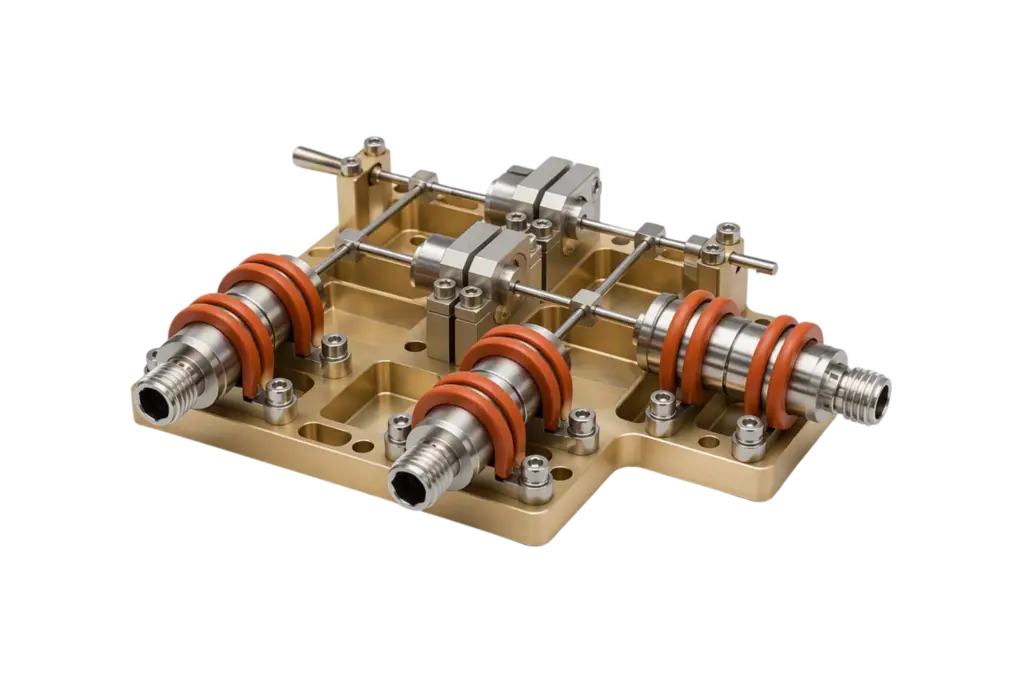
Integrate distribution channels, flow control features, filtration, and structural elements into one optimized component.
Reduce assembly complexity and eliminate potential leak paths associated with traditional manifold assemblies.
Improve propellant utilization and flow consistency through customized internal flow architectures.
Leverage decades of porous materials, filtration, propulsion, and fluid management experience.
Manufactured in Mott’s AS9100-certified facility in Farmington, Connecticut, supporting mission-critical aerospace and defense applications.
Work with Mott engineers to develop a lightweight, additively manufactured manifold tailored to your fluid routing, pressure, flow, and packaging requirements.

Join our newsletter to stay up to date on features and releases
Call us at 860.747.6333 or submit an information request form and someone will get back to you within 48 hours.
Headquarters:
75 Spring Lane
Farmington, CT 06032
Customer Innovation Center:
84 Spring Lane
Farmington, CT 06032