Life Support Filters, Ultra-High Purity for Critical Systems
When life support systems fail, lives are at stake. Our Filters deliver sub-ppt purity, minimal ΔP, and high regenerability, eliminating contamination risk in closed loop habitats.
Mott’s Life Support Filters are precision-engineered gas purification systems designed for critical applications in life support, aerospace, medical, and research environments. Leveraging Mott’s advanced porous metal & filtration expertise, filters remove contaminants such as moisture, hydrocarbons, particles, and trace impurities to ultra-high purity levels.

Questions? Call 860.747.6333 Today!
Mission-Critical Applications
- Oxygen Generating Systems / Oxygen Enrichment Modules
- Crew Cabin & Spacesuit Air Circulation / CO₂ Scrubbing Support
- Water Recovery & Wastewater Reclamation Loops
- Atmosphere Sampling & Instrument Flow Control
- Flame Arrestors & Ignition Mitigation
- Thermal Management / Loop Heat Pipe (LHP) Wicking Media
- Propellant & Monopropellant Conditioning (Hydrazine, Xenon feed)
- Particulate & Microbial Barrier Filtration for Recycled Fluids
Life Support Filters for Environmental Control & Life Support Systems
Download the cut sheet for Mott’s Life Support Filters, flight-proven porous metal filtration for oxygen, water, and air systems in spacecraft and life support. Configurable pore sizes, robust alloys, and aerospace-grade validation for mission-critical reliability.
High Purity Surface Mount Flow Restrictors
The Mott GSMR Series flow restrictors support the 1.125” high-flow C-Seal configuration gas systems.
The Mott Solution
When lives depend on clean, breathable air, there’s no room for contamination.
That’s why Mott’s Life Support Filters are engineered to protect critical life support systems – eliminating particles and moisture before they can compromise performance or safety.
Built with proprietary porous metal media, these filters withstand vibration, pressure swings, and corrosive gases. Each unit is laser-welded and cleaned to meet aerospace life-support standards:
- Sub-micron particle removal for oxygen and breathing gas purity
- Consistent flow performance under variable load and temperature
- Re-usable, cleanable construction extending system life
- No outgassing or fiber shedding — stable under long-duration missions
Product Specs
| Key Features & Benefits |
|
||||||||||||||||||||||||||||||||||||||||
|---|---|---|---|---|---|---|---|---|---|---|---|---|---|---|---|---|---|---|---|---|---|---|---|---|---|---|---|---|---|---|---|---|---|---|---|---|---|---|---|---|---|
| Specifications Table |
|
||||||||||||||||||||||||||||||||||||||||
| Standard Configurations |
Air Filters
Water Filters
|
||||||||||||||||||||||||||||||||||||||||
| Configurable Product Families & Use Cases |
|
||||||||||||||||||||||||||||||||||||||||
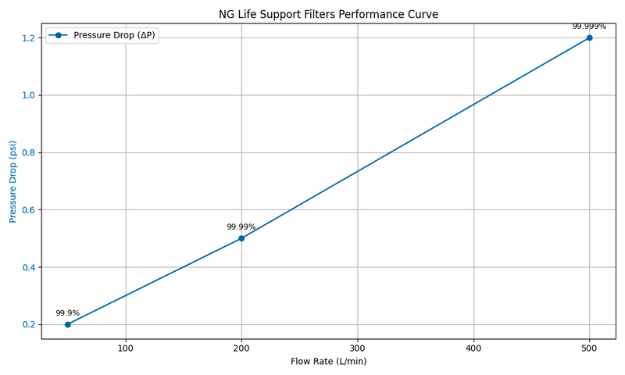
| Life Support Filters Performance Curve |
|
||||||||||||||||||||||||||||||||||||||||
| Ready to Test It in Your Tool? |



FAQs
Q: What contaminants can filters remove?
A: Filters are engineered to remove moisture, hydrocarbons, particulates (down to submicron), and trace impurities to parts-per-trillion levels.
Q: Can the filters be regenerated?
A: Yes — these filters are designed for multiple regeneration cycles (refer to spec sheet for cycle life).
Q: What are the typical pressure drop values?
A: As per spec, ΔP ranges from ~0.2 psi at lower flow up to ~1 psi at higher flow settings. See performance curves for details.
Q: Are these filters certified for medical / aerospace use?
A: Yes — they are built from materials with low outgassing, and can be qualified under applicable industry standards (please contact Mott for qualification documentation).
Q: How do I integrate filters into my gas delivery system?
A: They are designed to be installed upstream of point-of-use gas interfaces, with standard fittings, and can be incorporated in modular skid or loop designs.
